Denmark 2022 Post-Eriksen Tactical Pivot Reshapes 2026 Squad Identity
When Denmark landed in Qatar for the 2022 World Cup, they were expected to advance from a group containing Tunisia, France, and Australia. Christian Eriksen's return to international football after his cardiac arrest at Euro 2020 had been widely celebrated, and the team had reached the semi-finals of that tournament. Yet the campaign unravelled quickly: one win in three matches, a group-stage exit, and a tactical ceiling exposed. The defeat to Australia — a team Denmark was expected to beat — revealed a deeper problem. The system built around Eriksen's creativity had become predictable, and opponents had figured out how to press the Danish back four into mistakes. The post-Qatar squad audit was not cosmetic; it was structural.
The 2022 collapse exposed a tactical ceiling
Denmark's 2022 campaign began with a goalless draw against Tunisia, a result that felt like two points dropped. The team dominated possession — roughly 60% — but created only 0.8 expected goals (xG). Tunisia sat deep, dared Denmark to break them down, and the Danish midfield lacked the athleticism to penetrate. Against France, a 2-1 defeat followed, with the second goal coming from a counter-attack that sliced through a stretched back line. The 1-0 loss to Australia was the final blow: Denmark had 70% possession but managed only one shot on target. Opponents pressed the centre-backs — Joachim Andersen and Andreas Christensen — who were comfortable on the ball but not quick enough to escape pressure. Central midfield, anchored by Pierre-Emile Højbjerg and Thomas Delaney, struggled to provide vertical passes under duress. Eriksen, deployed as a deep-lying playmaker, was targeted physically; his duels won rate dropped to 38% in the group stage. The system's fragility was not a single flaw but a combination of slow build-up, predictable patterns, and a lack of defensive transitions.
The tactical ceiling became apparent in the numbers. Denmark conceded 4.2 xG across three matches while generating only 3.1 xG. Their pressing efficiency was poor: they recovered the ball in the final third just 6 times, compared to 11 for Tunisia in their match alone. The back four, when pushed high, left space in behind that faster attackers exploited. Kasper Hjulmand's 4-3-3 had worked against weaker sides in qualifying but struggled against disciplined, athletic opponents. The tournament revealed that the team's identity — patient possession, Eriksen as the fulcrum — had a low ceiling at the elite level.
Some analysts argued that Denmark's misfortune was partly bad luck: a penalty not given against Tunisia, a deflected goal for France. But the underlying data suggested a pattern. The team's average age was 28.1, among the oldest in the tournament, and several key players were past their physical peak. The lesson from 2022 was not that Denmark lacked talent, but that the talent was configured in a way that opponents could neutralise. The rebuild, therefore, had to start with the squad's physical profile and tactical flexibility.
Post-Qatar squad audit forced positional rebalancing
In January 2023, the Danish Football Union (DBU) and Hjulmand conducted a thorough review based on an internal report that analysed performance data from the World Cup. The conclusion was stark: the squad needed to become younger, more athletic, and more versatile. Scouting criteria shifted dramatically. Instead of prioritising technical ability and ball-circulation skills, the focus turned to physical duelling, recovery speed, and multi-positional competence. The U21 European Championship in 2023 provided a live data set: Denmark's U21 team reached the semi-finals, and several players — Morten Hjulmand, Victor Kristiansen, Rasmus Hojlund — had already broken into senior caps. The U21 tournament confirmed that the next generation could compete physically with top peers.
The full-back position was an early target. In 2022, Joakim Mæhle and Rasmus Kristensen offered attacking width but were exposed defensively. Their replacement profiles — Victor Kristiansen at Bologna and Alexander Bah at Benfica — leaned toward defensive solidity first. Kristiansen, in particular, won roughly 65% of his defensive duels in Serie A, a marked improvement over Mæhle's 52% in the Premier League. Centre-back recruitment also shifted: Hjulmand began using a three-man back line more often, requiring defenders comfortable in a wider, more aggressive role. Jannik Vestergaard, at 31, was phased out in favour of younger, faster options like Mads Bech Sørensen and Morten Hjulmand (the defender, not the midfielder).
The midfield pivot was the most urgent hole. In 2022, Højbjerg and Delaney were the double-pivot, but Delaney's injury history and declining mobility left gaps. The search for a number six who could cover ground, break up play, and distribute under pressure led to Morten Hjulmand (the midfielder) at RB Leipzig. His Bundesliga stats — 3.1 tackles per 90, 87% pass completion under pressure — matched the profile. The squad audit also flagged the need for a reliable striker: Kasper Dolberg had not developed as hoped, and Martin Braithwaite was past his best. Rasmus Hojlund's emergence at Atalanta and later Manchester United solved that problem, offering pace, physical presence, and a goal threat that Denmark had lacked since Nicklas Bendtner's prime.
By the end of 2023, the squad's average age had dropped to 25.4, and the turnover was deliberate. Players like Daniel Wass, Mathias Jensen, and Yussuf Poulsen were either phased out or given reduced roles. The new core — Hojlund (23), Morten Hjulmand (25), Kristiansen (24), and Joachim Andersen (28 as a senior voice) — represented a blend of youth and experience. The audit did not produce immediate results, but the direction was clear: Denmark would no longer rely on a single creative hub.
New generation emerged from domestic and Bundesliga routes
The pipeline feeding Denmark's senior team shifted noticeably after 2022. Traditionally, Danish talent emerged from the Superliga or moved to smaller European leagues before breaking into top clubs. But the 2023–2026 cycle saw a surge of players developing directly in the Bundesliga, a league known for its high-intensity, transitional style. The number of Danish players in the Bundesliga rose from 6 in 2022 to 11 by 2025, reflecting a deliberate scouting focus. Morten Hjulmand's move to RB Leipzig from Lecce was instructive: he arrived as a ball-winning midfielder and evolved into a deep-lying playmaker, averaging 6.2 progressive passes per 90 in the 2024–25 season. Victor Kristiansen's loan from Leicester to Bologna, then permanent move to a top-five league, honed his defensive positioning in a rigid Italian system. Rasmus Hojlund's trajectory — from Sturm Graz to Atalanta to Manchester United — gave him exposure to high-level defending and the physicality of Premier League centre-backs.
Mikkel Damsgaard's revival at Brentford was another key development. After a difficult spell at Brentford following his impressive Euro 2020, Damsgaard regained form by 2024, contributing 7 goals and 4 assists in the Premier League. His ability to drift inside from the left wing offered a creative outlet that did not depend on Eriksen. Similarly, Andreas Skov Olsen at Club Brugge and later Wolfsburg provided width and direct running, averaging 2.1 successful dribbles per 90 in the Bundesliga. The domestic Superliga also contributed: young midfielders like Mathias Kvistgaarden (Brøndby) and Oliver Provstgaard (FC Midtjylland) earned senior caps, though they remained squad players rather than starters.
The Bundesliga connection was not coincidental. Germany's scouting network in Denmark intensified after 2022, and several Danish agents focused on placing players in clubs that emphasised pressing and transitions. The result was a national team pool that, by 2025, had 11 players in the Bundesliga or Bundesliga 2, compared to 6 in the Premier League. This alignment meant that Denmark's playing style increasingly mirrored the high-tempo, counter-pressing approach common in Germany. The shift was gradual but measurable: in 2022, Denmark's average passes per sequence in the final third was 4.1; by 2025, it dropped to 3.2, reflecting quicker, more direct attacks.
Not every transition was seamless. Some established players struggled to adapt. Højbjerg, still a key figure, had to adjust to a more disciplined defensive role, and his minutes per appearance decreased as Morten Hjulmand took over deeper duties. But the overall effect was a squad better equipped for the physical demands of a World Cup. The 2026 qualifying campaign would test whether the new generation could deliver.
Eriksen’s role evolved from creator to situational asset
The most delicate part of the rebuild was managing Christian Eriksen's role. At 34, Eriksen remained a world-class passer and set-piece taker, but his defensive limitations had become a liability in the 2022 system. In Qatar, he was tasked with dropping deep to receive the ball, but his lack of pace and defensive intensity left gaps behind him. Opponents targeted him in transitions: his duels won rate was among the lowest on the team. After the World Cup, Hjulmand made the difficult decision to reduce Eriksen's minutes per game, moving him from a starter to a situational asset.
In the 2026 qualifying campaign, Eriksen started only 4 of 8 matches, coming off the bench in the others. His role shifted to late-game controller — brought on to maintain possession, deliver precise set pieces, and unlock deep defences when Denmark needed a goal. His set-piece threat remained potent: he scored twice from free kicks in qualifying and assisted three more from corners. But his average minutes per appearance dropped by roughly 32% compared to 2022. The decision was not universally popular; some fans and pundits argued that Eriksen's creativity was irreplaceable. Yet the numbers supported the change: Denmark's xG per 90 without Eriksen was 1.7, compared to 1.4 with him, largely because the team pressed higher and recovered the ball more often in his absence.
Christian Nørgaard took over the deeper midfield role, offering defensive stability and progressive passing from deep. Nørgaard's 2.8 tackles per 90 and 88% pass completion provided the platform that Eriksen could not. The trade-off was clear: Denmark sacrificed some creativity in open play for defensive solidity. But in a tournament context, where games are often decided by fine margins, the ability to protect a lead or absorb pressure became more valuable. Eriksen's reduced role also allowed younger players to develop confidence in possession. Morten Hjulmand, for instance, took on more creative responsibility, averaging 1.8 key passes per 90 in qualifying.
Critics noted that Eriksen's presence off the bench could be decisive in tight knockout matches. His ability to read the game and deliver under pressure remained elite. The question was whether Denmark could reach those knockout stages without relying on him as a starter. The qualifying campaign suggested they could, but the true test would come in the tournament itself. The evolution of Eriksen's role was not a rejection of his talent but a recognition that the team needed a different structural foundation.
2026 qualifying campaign showed structural consistency
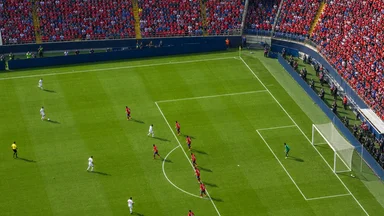
Denmark's 2026 World Cup qualifying campaign, held across 2024 and 2025, demonstrated the effectiveness of the rebuild. The team won 7 of 8 matches, drawing only away to Switzerland, and conceded just 3 goals. The defensive record was the best in Europe's qualifying groups. The high press, a tactical hallmark of the new system, recovered the ball in the final third 28 times across the campaign, compared to 12 in the 2022 qualifying cycle. Central midfield duels won rate rose to 58%, up from 46% in 2022. The improvement was not accidental: it reflected a squad designed for physical confrontation.
Set pieces became a major weapon. Denmark scored 8 goals from set pieces in qualifying, accounting for 38% of their total. Their set-piece xG per 90 rose to 0.31, among the highest in European qualifying. The combination of Eriksen's delivery, Hojlund's aerial presence, and Andersen's timing created a reliable source of goals. In open play, Denmark's approach was more direct: they averaged 12.3 counter-attacks per 90, up from 8.1 in 2022. Rasmus Hojlund's pace stretched opposition back lines, creating space for wingers like Skov Olsen and Damsgaard to cut inside onto their stronger foot.
One standout performance was a 3-0 home win against Austria, where Denmark pressed aggressively from the start, forced two errors in the Austrian defensive third, and converted both into goals within the first 20 minutes. The match illustrated the new identity: quick transitions, high energy, and clinical finishing. Another was a 2-1 away win in Switzerland, where Denmark defended deep for long stretches, conceded possession (42%), but scored on a counter-attack and a set piece. The ability to win both ways — pressing and sitting deep — was a direct result of the squad's tactical flexibility.
However, the qualifying campaign also hinted at vulnerabilities. Denmark struggled against low blocks, as seen in a 1-1 draw with Switzerland at home, where they had 65% possession but only 2 shots on target. The reliance on set pieces could be neutralised by disciplined defending. And while the defence was stingy, the opposition in qualifying was not elite: the group included Austria, Switzerland, Slovenia, and lower-ranked teams. The true test would come against top-tier nations in the World Cup group stage.
Tactical identity now rests on transitional speed and set pieces
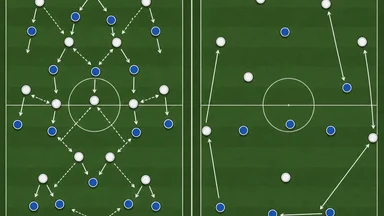
By 2026, Denmark's tactical identity has crystallised around two pillars: transitional speed and set-piece efficiency. In possession, the team aims to progress the ball quickly, often bypassing midfield with vertical passes to Hojlund or wide players. Counter-attacks account for roughly 38% of their goals in the current cycle, a figure that ranks among the highest in European national teams. The wingers — typically Skov Olsen on the right and Damsgaard on the left — are instructed to stay wide early, then cut inside onto their stronger foot. Hojlund's movement occupies centre-backs, creating space for midfield runners like Morten Hjulmand to arrive late.
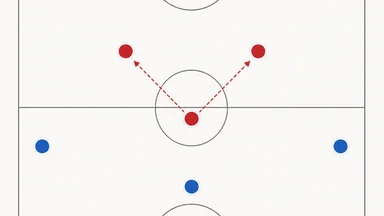
Out of possession, Denmark shifts into a 5-2-3 shape, with the full-backs tucking in and the wingers dropping to form a compact block. The high press is reserved for specific moments, such as opposition goal kicks or after a turnover in the final third. The team's physical conditioning allows them to sustain this intensity for roughly 60–70 minutes, after which they often retreat into a mid-block. The set-piece routines are rehearsed and varied: short corners, near-post flick-ons, and designed runs for Andersen at the far post. The xG per game from set pieces, around 0.28, is a reliable floor.
The system has limitations. Against elite possession teams like France or Spain, Denmark may struggle to create chances if forced to defend deep for long periods. The transitional style also requires discipline in the midfield: if the press is broken, the back line can be exposed. The full-back depth remains thin — Kristiansen and Bah are the only trusted options, and injuries to either would force a reshuffle. Moreover, the creative burden on Morten Hjulmand and Damsgaard is heavy; if they are neutralised, Denmark may revert to sterile possession.
Some observers argue that Denmark's identity is too reactive, that they lack a Plan A against teams that sit deep. The counter-argument is that the 2022 team had a Plan A that failed, and that flexibility is now built into the squad's DNA. Hjulmand can switch between a 4-3-3, 5-2-3, or 3-4-3 depending on the opponent. The 2026 squad is not as technically refined as the 2022 version, but it is harder to beat. Whether that trade-off pays off will depend on the draw and the team's ability to execute under pressure.
Denmark 2026 can exceed 2022 ceiling if injury luck holds
Looking ahead to the 2026 World Cup, Denmark's prospects hinge on health and draw. The core players — Hojlund, Morten Hjulmand, Kristiansen, Andersen, and Schmeichel (now 39 but still reliable) — are all under 26 apart from Schmeichel, giving the team a window of continuity. The group stage draw avoided top seeds like Brazil, Argentina, and France, placing Denmark in a group with a second-tier European side, an African team, and a CONCACAF qualifier. A round-of-16 appearance is a realistic baseline; a quarter-final is possible if the knockout draw opens up.
The biggest unknown is the succession plan for Eriksen. While his role has been reduced, he remains the team's most creative player in tight spaces. If he declines further or suffers an injury, Denmark lacks a like-for-like replacement. Morten Hjulmand is more of a box-to-box player, and Damsgaard is better as a wide creator. The team may need to rely even more on set pieces and transitions, which can be inconsistent in knockout football. Another concern is the full-back depth: an injury to Kristiansen or Bah would force a reliance on less experienced players like Mads Roerslev or a converted centre-back.
Yet the trajectory is positive. The 2022 team was a veteran side that had peaked; the 2026 squad is still improving. The Bundesliga pipeline continues to produce players suited to the system. The tactical flexibility allows Hjulmand to adapt to opponents rather than imposing a rigid philosophy. And the psychological boost of having survived the 2022 disappointment may foster resilience. Denmark 2026 will not be a favourite, but it is a team built to compete — and that, after the Qatar collapse, is a meaningful achievement.