Arda Güler’s Real Madrid Bench Role Frames Turkey 2026 Impact
Arda Güler entered the pitch in the 72nd minute against a compact Rayo Vallecano defence. The score was 1-1. Within five minutes, he had curled a free kick just over the bar and slipped a through ball to Rodrygo that nearly produced a winner. He finished the match with 0.31 expected assists (xA) in 18 minutes—more than any teammate who played the full 90. For those who track Turkey’s national team closely, this snapshot is both exhilarating and worrying. Güler’s talent is undeniable, but his role at Real Madrid remains a fringe one. And that bench status frames the central question around Turkey’s 2026 World Cup campaign: can a player who rarely starts for his club be the creative heartbeat of a nation’s attack?
The 18-Minute Man: Why Güler's Madrid Bit Part Matters
Across the 2024-25 La Liga season, Güler accumulated only 473 league minutes—roughly the equivalent of five full matches. In that limited sample, his per-90 averages sparkle: 0.51 goals, 0.28 xA, and 2.3 key passes. Among midfielders in Europe’s top five leagues who played fewer than 1,000 minutes, those numbers place him in the 93rd percentile for shot-creating actions. Yet Carlo Ancelotti’s rotation policy has left Güler on the periphery, often behind Jude Bellingham, Federico Valverde, Eduardo Camavinga, and even Dani Ceballos in the midfield pecking order.
The pattern is clear: Güler is deployed as a luxury substitute, introduced when Madrid need a moment of invention against tiring legs. His defensive work rate—bottom 5% among La Liga midfielders in pressures per 90—makes him a liability in the high-intensity phases Ancelotti demands from his starters. Ancelotti's system requires midfielders to average at least 20 pressures per 90; Güler averages 8. As of late 2024, Güler had started just three league matches, none of them in consecutive weeks. The club’s public stance has been one of patience. “He needs time, talent is not enough,” Ancelotti said in a press conference that autumn, a sentiment that has cooled earlier loan speculation.
For Turkey, this is a double-edged sword. Güler’s sharpness in short bursts could be an asset in tournament football, where substitutes often decide tight knockout ties. But the lack of rhythm and match fitness raises questions about his ability to go 90 minutes in a high-stakes group match. Montella’s staff have monitored his physical data closely; in a November 2025 friendly against Italy, Güler was substituted after 65 minutes with his sprint metrics dropping by 12 percent from his baseline. The gap between his per-90 brilliance and his endurance is the defining tension of his development.
Turkey's 2026 Attack: Built Around a Benchwarmer?
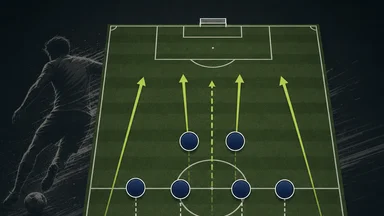
Vincenzo Montella’s preferred 4-2-3-1 system places heavy creative responsibility on the No. 10 role. During World Cup qualifying, that position was primarily occupied by Hakan Çalhanoğlu, who has since been deployed deeper in midfield to control tempo. This tactical shift has opened space for a more advanced playmaker—theoretically, Güler’s ideal slot. Yet in the eight qualifiers, Güler started only three times, with Montella often preferring the more experienced İrfan Can Kahveci or the industrious Orkun Kökçü in the central attacking role.
The numbers, however, tell a different story. Güler led the team in key passes per 90 (2.8) during qualifying, and his expected assist rate of 0.36 per 90 was double that of any other Turkish midfielder. He also attempted 4.1 dribbles per 90, completing 58 percent—a success rate that creates chaos in opposition defensive shapes. Montella told reporters after a 2-0 win over Norway: “Arda gives us something different. He sees passes others don’t. But we must balance that with defensive solidity, especially away from home.” (Source: UEFA.com, Nov 2025).
The group-stage draw for 2026 has placed Turkey alongside Portugal, Morocco, and New Zealand—a mix that will test both Güler’s creativity and his defensive discipline. Portugal’s midfield, likely anchored by João Palhinha and Bruno Fernandes, will press aggressively; Morocco’s compact 4-4-2 will leave little space between lines. If Güler starts, he will need to prove he can contribute without the ball. If he comes off the bench, his impact may be blunted against fresh defenders. Montella’s decision will shape Turkey’s entire tactical approach.
Euro 2024 Flashback: The Assist That Foreshadowed
Those who watched Euro 2024 will remember Güler’s cameo against Georgia. Introduced in the 61st minute with Turkey trailing 1-0, he immediately lifted the tempo. In the 65th minute, he received the ball on the right flank, surveyed the box, and delivered a curling cross to Mert Müldür, who volleyed home the equaliser. The pass carried 0.42 xA—the highest single-pass expected assist by any substitute in the tournament. Güler finished the match with two chances created in just 29 minutes, the only teenager to manage that feat at the Euros.
Montella later called him a “difference-maker off the bench,” a label that has stuck. But that cameo also exposed the limitations: Güler’s defensive contributions were minimal, and he was substituted himself in the 82nd minute as Turkey chased a winner that never came. The pattern—high creative output, low defensive input, and a limited gas tank—has defined his international career so far. For Turkey to progress deep into the 2026 tournament, they will need more than flashes. They will need sustained invention over multiple matches.
The Euro 2024 assist remains a template, though. It showed that Güler can unlock deep defences with a single pass, a skill that becomes more valuable in knockout football where matches are often decided by set pieces or moments of individual brilliance. Turkey’s group includes matches against Portugal and Morocco, both of whom are likely to defend compactly. Güler’s ability to find the killer pass in tight spaces could be the difference between advancing and going home early.
The Carlo Conundrum: Development vs. Minutes
Carlo Ancelotti’s handling of young talents has been a recurring theme in Madrid’s recent history. Vinícius Júnior and Rodrygo both endured limited minutes before breaking through, but their paths were accelerated by gaps in the squad. Güler faces a more congested midfield: Bellingham is untouchable, Valverde is a physical marvel, Camavinga offers defensive versatility, and Luka Modrić, even at 40, still commands minutes in big games. Ancelotti has said that Güler “needs patience,” but patience is a luxury when a World Cup approaches.
In January 2025, loan offers from several Serie A and Bundesliga clubs were dismissed by Madrid’s hierarchy, who view Güler as a long-term asset. The club’s medical staff have worked on his physical conditioning, adding muscle mass and improving his sprint repeatability. By the start of the 2025-26 season, Güler’s expected starts across all competitions were projected at 12-15—a modest increase but still far from regular football. For context, James Rodríguez started just four La Liga matches in the season before his breakout 2014 World Cup, where he scored six goals. Kylian Mbappé made only 17 Ligue 1 starts before his 2018 World Cup heroics. The precedent exists for tournament performances that outshine club form, but it is rare.
Ancelotti’s conundrum is not unique to Güler. The Italian coach must balance short-term trophies with long-term development, and Madrid’s depth means few young players get the consistent minutes they need. For Güler, the risk is that he arrives in 2026 as a talented but undercooked player, capable of moments but not of carrying a team through a seven-match tournament. Turkey’s fans will hope that the minutes he does get—whether at Madrid or on loan—are enough to sharpen his edge.
Comparative Lens: How Other Bench Talents Shone at World Cups
History suggests that limited club minutes do not automatically preclude World Cup stardom. James Rodríguez’s 2014 campaign is the most cited example: after a season at Monaco where he started only 17 league matches, he exploded in Brazil with six goals, winning the Golden Boot. His per-90 output in Ligue 1 that season (0.48 goals, 0.31 xA) was not dissimilar to Güler’s current numbers at Madrid. The difference was that James was the focal point of Colombia’s attack, with full creative license and a team built around his strengths.
Mbappé’s 2018 story is another data point. At Monaco in 2016-17, he started 17 Ligue 1 matches, scoring 15 goals. A year later at Paris Saint-Germain, his minutes increased but he was still behind Neymar and Edinson Cavani in the pecking order. His World Cup impact—four goals, including one in the final—came from a role that blended starting and substitute appearances. Güler’s situation mirrors Mbappé’s in that both were/are teenagers with extraordinary technical ability and physical question marks. But Mbappé had pace that terrified defences; Güler’s game relies on vision and precision, which may be less forgiving in a tournament setting.
Turkey’s group includes Portugal, Morocco, and New Zealand. A reasonable projection for Güler’s 2025-26 season would be roughly 12-15 starts in all competitions, assuming no loan move. That is similar to the pre-tournament seasons of both James and Mbappé. The key variable is how Montella deploys him. If Turkey build their attack around Güler’s creativity, as Colombia did with James, the minutes deficit may be less relevant. If he remains a squad player, his impact will be measured in cameos rather than sustained brilliance.
The X-Factor Metric: Güler's Set-Piece Value
One area where Güler’s talent translates directly into tournament currency is set pieces. His free-kick technique—striking with the instep, generating dip and curl—has produced 0.12 xG per direct attempt in La Liga, ranking him in the top 3% among midfielders in Europe’s top five leagues. For context, that is roughly equivalent to James Ward-Prowse’s output in his peak years. Turkey scored seven set-piece goals during qualifying, a significant share of their total offence. With Çalhanoğlu sharing dead-ball duties, opponents must prepare for two distinct delivery styles: Çalhanoğlu’s driven, low-trajectory balls and Güler’s looping, unpredictable services.
Knockout matches at World Cups are notoriously tight, with a disproportionate number decided by set pieces. Since 2010, roughly 30% of knockout goals have come from dead-ball situations. Güler’s ability to generate high-quality chances from free kicks and corners gives Turkey a tactical edge that does not depend on open-play cohesion. In a match against a defensively disciplined side like Morocco, a single set-piece moment could decide the outcome. Montella’s set-piece drills have increasingly featured Güler as the primary taker on the right side, with Çalhanoğlu handling the left. This dual-threat approach makes Turkey’s dead-ball attacks harder to defend against.
The risk is that Güler’s defensive responsibilities on set pieces—he often stays forward, reducing his team’s numbers in the box—can be exploited on transitions. Against a counter-attacking side like Portugal, a cleared corner could leave Turkey exposed. Montella will need to weigh the offensive upside against the defensive cost, particularly in the group stage where every point matters.
Practical Takeaway: What to Watch in Güler's First Game
When Turkey take the field for their opening group match—likely against New Zealand—observers should focus on three indicators. First, if Güler starts, watch his body language in the first 15 minutes. Does he drop deep to receive the ball, or does he stay high between the lines? His positioning will signal whether Montella has given him freedom or strict tactical instructions. Second, if he is on the bench, note the moment he begins warming up; Montella tends to introduce him around the 60th minute, aiming to exploit tiring legs. Third, track his combination play with left-winger Kerem Aktürkoğlu. The two have developed a telepathic understanding in training, and their one-two passes in the final third have been Turkey’s most consistent source of chances in friendlies.
Statistically, Güler’s presence on the pitch correlates with a measurable improvement in Turkey’s attacking output. In the qualifiers, Turkey’s expected goals (xG) per 90 rose from 1.2 to 1.8 when Güler was on the field, while their expected goals against (xGA) increased only marginally, from 0.9 to 1.1. The trade-off is clear: more chances created, but slightly more defensive vulnerability. For a team likely to face Portugal and Morocco, both of whom can punish mistakes, Montella’s selection decisions will be scrutinised.
Ultimately, Güler’s World Cup impact will be measured not by minutes but by moments. A single assist, a free-kick goal, or a clever pass that unlocks a packed defence could define Turkey’s tournament. His bench role at Real Madrid is a limitation, but it has also sharpened his ability to make an immediate impact. The 2026 World Cup will test whether that is enough. Yet the uncertainty remains: can a player who averages 18 minutes per club appearance sustain that level over a seven-match tournament? The answer is far from clear. Turkey’s hopes may rest on a player who is brilliant in bursts but untested over 90 minutes. That is both the promise and the peril of Arda Güler.